
Tennis stats explained
Tennis stats turn a match into numbers you can compare: how often a player gets the first serve in, how many points they win on serve and return, and whether they win points or give them away. Below is what each statistic means, how CourtDuo Stats calculates it, and what a coach usually looks at.
Serve
1st serve in
Meaning: how often the first serve lands in. Calculation: a player's service points played on a first serve, divided by all of their service points. A coach looks at it together with the next figure: a high number built on a very safe serve may cost points elsewhere.
Points won on 1st and 2nd serve
Meaning: how well the player does once the point starts. Calculation: for the 1st serve, the points won out of the service points where the first serve went in. For the 2nd serve, the points won out of the service points played on a second serve. A coach looks at the gap between the two: a big drop on the second serve points to a second serve that is too soft or too risky.
Aces and double faults
Meaning: points won or lost with the serve alone. Calculation: plain counts of aces and double faults among the player's service points. A coach looks at double faults first, especially at important points, because they hand over a point for free.
Break points saved
Meaning: how the player holds serve when the opponent has a chance to break. Calculation: the break points the player faced on serve, and how many of them they won. CourtDuo Stats shows it as a fraction, such as "3 of 5", not as a percentage, because break points in one match are a small sample. A coach looks at it over several matches rather than one.
Service games won
Meaning: how often the player holds serve. Calculation: the player's own service games won, out of the service games that were completed. Tie-breaks are left out, because serve changes during a tie-break. A coach looks at whether the player holds serve easily or is always fighting.
Return
Points won returning 1st and 2nd serve
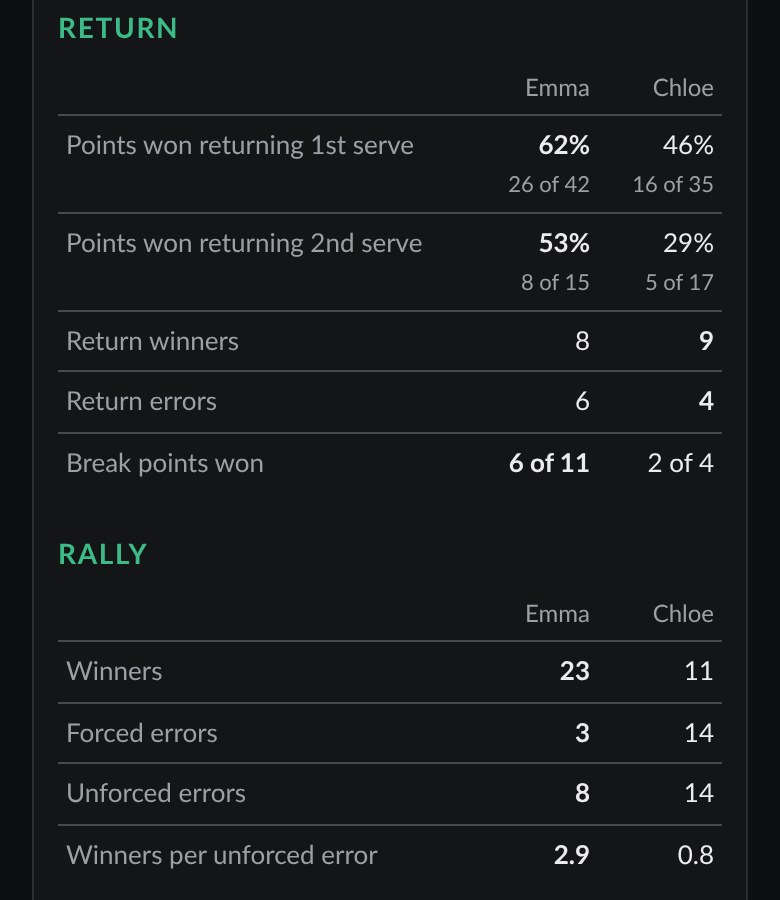
Meaning: how well the player handles the opponent's serve. Calculation: the points the player won, out of the opponent's service points played on a first serve, and separately on a second serve. A coach looks at the return of the second serve in particular, since that is where a returner can attack.
Return winners and return errors
Meaning: returns that won the point outright, and returns that missed. Calculation: plain counts. A coach looks at the balance: many return errors can mean the player is trying too much, and no return winners can mean they are only getting the ball back.
Break points won
Meaning: how well the player takes the chance to break serve. Calculation: the opponent's break points faced, and how many the player converted, shown as a fraction such as "2 of 6". A coach looks at how many chances the player created and how many they used.
Rally
Winners, forced errors and unforced errors
Meaning: a winner is a shot the opponent could not reach. A forced error is a miss caused by real pressure from the opponent. An unforced error is a miss from a ball the player could normally handle. Calculation: plain counts per player, attributed to the player who hit the last shot. The line between forced and unforced is a judgement made by the person scoring. A coach looks at unforced errors most closely, since they are the points a player gives away.
Winners per unforced error
Meaning: how a player's attacking compares with their mistakes. Calculation: winners divided by unforced errors, to one decimal. It shows a dash when the player made no unforced errors. A coach looks at whether the player's risk-taking pays off.
Points by rally length
Meaning: who wins the short, the medium and the long points. Calculation: points that ended in a winner, a forced error or an unforced error, and that have a recorded shot count, are put into three groups: 1-4 shots, 5-9 shots and 10 or more shots. Each player's figure is the share of those points they won. A coach looks at which length the player wins most, and which they avoid.
The formulas at a glance
| Statistic | Calculated as |
|---|---|
| 1st serve in | service points on a first serve ÷ all own service points |
| 1st serve points won | points won ÷ service points where the first serve went in |
| 2nd serve points won | points won ÷ service points played on a second serve |
| Break points saved | break points won on serve, out of break points faced |
| Service games won | own service games won ÷ completed service games, tie-breaks excluded |
| Points won returning 1st or 2nd serve | points won ÷ the opponent's service points on that serve |
| Break points won | the opponent's break points converted, out of those the opponent faced |
| Winners per unforced error | winners ÷ unforced errors |
| Points by rally length | share of winner or error points with a recorded shot count that the player won, for 1-4, 5-9 and 10+ shots |
A note on small samples
One match, especially a short one, is a small sample. A single bad game can move a percentage a lot. Look for patterns over several matches before you change anything in training.
How CourtDuo Stats helps
CourtDuo Stats calculates every figure above from the points you tap, for the whole match and for each set. If you did not record a detail for some points, such as the shot count, the page says how many points the figure is based on instead of quietly showing a number. The free Solo plan shows basic figures; the full set comes with the Duo plan, the Coach plan or a Match pack. See all of it in the example match.
Want to collect these numbers yourself? Read how to track tennis match stats.